
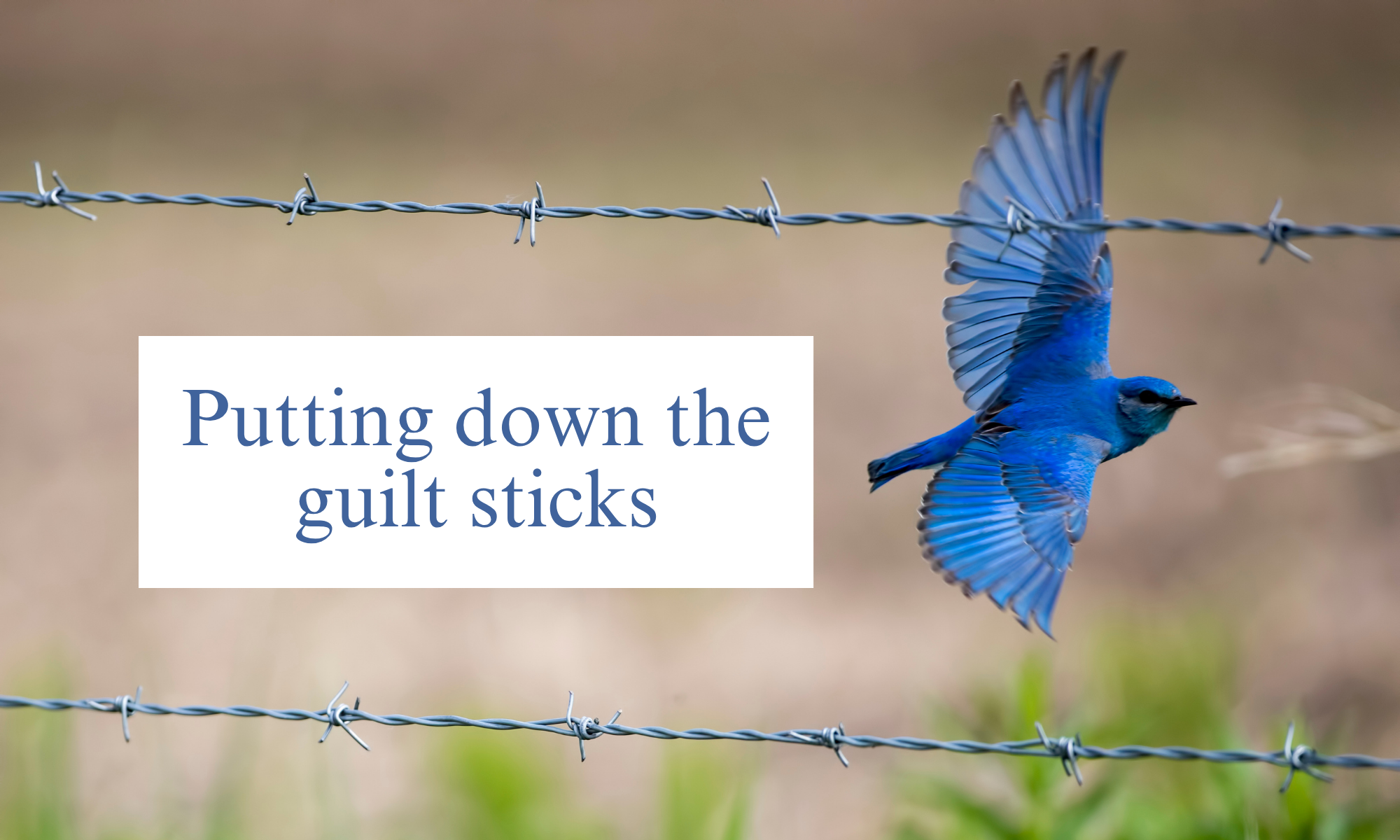
If you saw two children in a park, and one was hitting the other one with a stick, would you just watch it happening, not do anything to stop it, and just listen to the child’s feelings afterwards?
If the stick-hitting was happening day in and day out, would you still keep watching and not taking action?
Or would you go in and offer a loving limit with the stick-hitting?
This is a metaphor for what so often happens here in the Disconnected Domination Culture – that we might listen to the guilt we feel, but not stop the source of the guilt.
I’m here to help people stop the guilt at the source, rather than respond to the effects.
I am deeply passionate about this.
Have you ever wondered why you keep hitting yourself with guilt sticks?
Guilt sticks include “shoulding” yourself into doing things, and “shoulding” yourself (e.g. “I shouldn’t have done that) after doing things
Guilt sticks are emotional sticks that lead to emotional bruises.
With guilt sticks, the emotional bruises are guilt.
They are the pain that you feel when you believe those harsh guilt words that go through your consciousness.
So, why do you hit yourself with those guilt sticks? (If you do).
Those words, or the flavour of those words were originally words you heard when you were a child – from someone else.
When you first heard those words, I imagine you felt emotional pain. Perhaps even shock, in response to hearing these words.
But over time, you started to believe them.
Your need to belong, to be loved, to be included, meant that you internalised those words and identified with them.
It was vital for you to do that, in order to fit into the family, culture, and era you were born into.
But by now, you may have hurt yourself with guilt way more times than you were originally hurt.
Did you know that continuing to believe those words about yourself is a choice?
Did you know that it is possible to stop believing them?
How do I know that?
Because I used to be more filled with self-judgment, shame, shoulds, guilt, and emotional bruises from emotional sticks than anyone else I know (apart from my Mum, who I learnt them from – and I have supported her to get relatively free from them).
I’d feel guilty and ashamed so much of the time.
And now my internal dialogue is very different.
It’s full of compassion and empty of judgment.
I don’t ever feel guilty.
And I very very very rarely ever feel shame – maybe once every year, and if so, generally only for a few seconds, before I put the shame stick down.
How can you stop hitting yourself with those guilt sticks?
One step can be to ask yourself if you’re willing to stop hitting yourself with those sticks.
You might be interested to hear the answer!
Often as children we were told that we were being punished “for our own good”. (An Alice Miller term).
The whole behaviour modification paradigm is based on the belief that punishment (which guilt is a form of) is “good” for a child because it makes them ‘behave’ and become a helpful member of society.
So, when you ask yourself if you’re willing to stop hitting yourself with emotional sticks, you might find that you’re concerned that if you didn’t feel guilt or shame, that you might spend all day lying on the couch eating chocolates and watching Netflix.
If something like that comes up for you, I’d recommend the magic of compassion plus encouragement.
(This is basically The Willingness Practice. You’re asking yourself if you’re willing to stop hitting yourself with emotional sticks and you’re helping yourself maximise you connecting with your willingness!)
The compassion might be your Inner Loving Mother or the Divine Mother or any compassionate archetype you connect with, saying things like,
“I hear that you’re worried that if you stop feeling guilt and shame, you’ll spend all day lying on the couch eating chocolates and watching Netflix. I really honour how much you value doing things that are meaningful for you / being present with your children / going to work / connecting with your partner (or whatever else it is that you value that wouldn’t be honoured if you did spend all day on the couch).”
Once you’ve done this for a while, you might notice that you breathe a sigh of relief, or that your body feels lighter, or you feel more willingness.
After that, you might want to invite in your Inner Loving Father, the Divine Father, or the part of you that loves clarity and encouragement and logical thinking.
You might want to hear all the ways that you know that you wouldn’t spend all day every day on the couch. You might hear encouragement that you would actually be MORE loving, more connected with your kids, more relaxed, a more loving partner, or whatever it was that you were concerned wouldn’t happen if you stop hitting yourself with those emotional sticks!
Then you can ask again if you’re willing!
Another step might be becoming more aware of the guilt sticks and their effects on your body and feelings and behaviour.
This can be a painful step, so any compassion that you can bring in at this time is so important.
Often we’ve internalised these ways of thinking so much that we don’t even realise that they are there.
For example, you might feel guilt but you might not have noticed that before the guilt came the should thoughts, that you took in.
If you’re a parent, you might notice that when you should yourself about your parenting, you feel guilty, and then you are more frustrated when your child asks you something.
You might notice that if you should yourself after doing something, you feel guilt, and then you retreat from connection.
As we become more aware of the thoughts, and the feelings and sensations that they create in our bodies, and the behaviour that often leads to, that awareness in itself means that our identity is expanding.
If we are aware of the thoughts and the resulting feelings, then by definition, that means that we are not that.
As we become aware, we are expanding our capacity to be more. This awareness is a vital part of the process. (Yet, awareness is not enough.)
As you develop this awareness, another step, which is SO important, is to start developing an inner voice of compassion.
This can also be hard at first.
One suggestion I have is to imagine your child is your age and in the situation that you are in, and you were the grandparent, and to connect with what kinds of things you would say to yourself. Another way is to ask yourself what kinds of compassionate words you enjoy saying to your child.
Then you can start choosing to say those words to yourself.
Now, just as if an outer parent is talking to an upset child who hasn’t been heard, the child parts might say, “I don’t believe your,” or, “I hate you,” or, “You didn’t listen before so I don’t trust you,” and those kinds of things.
If you have any of those kinds of responses to your Inner Loving Mother or Inner Divine Mother or the inner loving voice, then those are part of the healing.
She can hear these parts and their feelings.
“I hear that you don’t believe me, sweetheart, and I’m still here, and I’m listening. I will keep on loving you.”
“I hear that you hate me, lovely, and I’m right here, and I’m listening. I love you.”
“I hear that you don’t trust me, sweetie, and that it was painful to not be heard. Please take as much time as you need to trust me.”
As this process continues, you might notice that you become more aware of the harsh words, and you might notice that you start choosing to replace the word, ‘should’ with the word, ‘choose.’ That might help reduce the guilt.
There are a few different ways of dis-identifying from the harsh thoughts.
One way is to see them as parts of us that are trying to get needs met, and to embrace those parts of ourselves and to listen to the values and needs that underly them.
But for me, I found that I believed them so much that doing that didn’t help.
So my own personal preference has been be unwilling to believe the guilt thoughts, and this is what I teach in The Marion Method.
And to be willing replace them with compassionate thoughts instead.
There are a few different ways of thinking about this.
One way I like to think about this is that the thoughts are like a menu of consciousness.
A thought comes to us, and it is like a waiter showing us a menu, and this thought is on the menu.
And we’ve observed that a certain thought leads to a certain feeling and then the likelihood of a certain behaviour – eg. when we should ourselves, we feel guilt, and then we retreat or speak harshly to our child.
That’s like knowing that if I choose an ice cream from the menu, I’m going to feel agitated and I’m likely to be really spaced out with my children.
So, just like we can choose the physically healthy option, by saying, “No” to the ice cream on the menu, and choose something that we love instead, so can we say “No” to thoughts that lead to us feeling guilt, and instead choose a thought that will feel enjoyable to hear, and that will lead to lovingness and willingness.
For this metaphor, it can really help to think of a food that you really hate, and would NEVER say yes to at a restaurant, and a food that you ADORE and would ALWAYS say yes to at a restaurant, and then you can think of those two foods whenever the harsh judgmental thoughts come around.
Linking it like that can help you find it easier to say no to what will hurt you, and yes to what will nourish you.
And when we start making choices like this, that is when we are developing our connection with our Soul of Love and Will. Love and Will are two qualities of the centre of ourselves. So, once we have loving awareness, we can then start making choices.
Instead of coercion, we can act from willingness.
Instead of self-judgment, we can start to choose compassion.
Another way I enjoy is remembering the scene in the Matrix when Neo gets brought back to life by Trinity’s love, and then says a clear “no” to the bullets, and they stop. He takes one and they all drop to the floor.
That is exactly my experience.
There’s compassion (Love) first, then the Neo No (Will).
When I was learning to be unwilling to believe self-judgments, I would literally imagine putting my right hand up to my upper right side and saying, “no.” This is another form of a Neo No. It’s not harsh or angry, it’s simply, “no, I am not willing to imbibe that. I am not willing to take it into me. I’m not willing to believe it to be true.”
And then the apparent reality of that thought dissolves away.
It wasn’t ever true.
It was simply a thought that has been passed down from generation to generation.
It’s not true, and it never has been, and it never will be.
It’s like the two children at the park. It’s simply saying, “I’m not willing for you to hit her with the stick.”
Sometimes that might be a gentle invitation instead. Perhaps your Inner Loving Father might say, “sweetheart, I invite you to stop hitting yourself with that stick.”
We each have our own way to change our inner dialogue.
To me, it’s important that these loving words aren’t affirmations, because then it’s just a part of us that doesn’t believe it telling another part of us that doesn’t believe it.
To me, it’s important to hear all the thoughts that need to be heard when we receive unconditional love.
To me, it’s important to connect with a part of us that knows these loving and compassionate words to be true, so that they can tell the part that doesn’t believe it, and it’s a real conversation.
This process, of changing our inner dialogue from harsh to loving, isn’t instantaneous.
But it IS possible.
I wonder whether you would like to be freer from hitting yourself from emotional sticks of guilt.
And if so, what is your next step in this process?
Your own journey will be unique, so I invite you to trust yourself.
Focussing on one thing can be helpful. What would you like to focus on as your next thing?
And if you’re interested to dive in deeper, and receive support to get free from guilt, I invite you to come and have a look at my Get Free From Guilt 2.0 Course!
Big love,
Marion
xoxox
P.S. This is part of The Marion Method, not Aware Parenting, and was deeply influenced by Nonviolent Communication, by Marshall Rosenberg, PhD.